Two Nice reviews from Heathen Harvest:
Sin:Ned / Nerve - Ghost Feeding Vessel
This is a split release between Sin:Ned and Nerve.
This split album from Hong Kong locals Sin:Ned and Nerve is a recorded performance on the eve of the Chinese Ghost Festival as accompaniment to a multimedia installation of video projection by two other artists at the Para/Site Art Space. It is a spatially haunting piece endemic to both region and intention – discernibly Asian and noticeably supernal.
The quality of the single track that sheds skin and phantasmagoria over a little less than forty minutes is to be commended for a live recording, the electronics so pristine they finely shave away all low-fi or hazed excesses yet despite the digital crystallisation is not frigid.
Intended to serve as a bridge those in this world and those in the next, ‘Ghost Feeding Vessel’ is thankfully not a dolorous drone of decay and depression for it is far too electric and chaotic. Bell chimes limn the air like the fragrance of jasmine, delicate and almost imperceptible; flutes flit and dart in Asian scale tones down to their quarters as swift as the smallest of winged birds; gongs explode showers of golden dust; even the more electronic oscillating susurrations are treated with a light deftness and inveigle the senses. Sounds coalesce and crescendo in attempt to force embrasure.
Several movements collate ‘Ghost Feeding Vessel’ with the middle section less ghostly than the lead-in as electronic glitches patter little rhythms with the sampled noise of dust. The last movement, however, seems to step away from the realms of spirits and becomes mired in an urban maelstrom of squalling frequencies and rapid and uncontrolled leaps of percussion. This detraction seems to close more than open the aperture into the formless.
The album is a limited affair, one-hundred CDr copies are presented better than the average slap-together, with a black silk-screen coated disc (quite a rarity for a CDr) and heavy gloss card in full colour. An intriguing symmetrical icon burns an optical illusion with lens flare that has your pupils dilating. (symbolique)
http://www.HeathenHarvest.com/article.php?story=20090209184057101
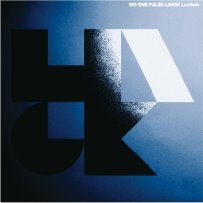
No One Pulse - LINGK
The Hong Kong duo of Wong Chung-fai (Sin:ned, Music Colony Bi-Weekly Magazine) and Chau Kin-wai (Sleepatwork) recording as No One Pulse, specialise in conceptually minimalistic, but broadly-painted, soundscapes, utilising electronic blips, hums and squeaks. In their own terms these are micro-sound experiments and “freeform” electronics, collated and built from both studio-based and live recordings. There are hints of a certain formalism to some of the microstructural minutiae of the compositions, but above and beyond that the pair introduce elements of random interpolations and chaotic improvisation. This is not to imply any Stockhausen-style atonality is present – rather, in much the same way that matter behaves in the real world, structures are allowed to emerge out of the randomicity without attempting to confine the music into any theoretical straitjacket. What we have then could be said to mimic the natural processes, albeit on a smaller scale, that form the bedrock of material existence around us.
I have to advise that I use the word minimal very loosely here – the sounds employed are in essence very few in number, but stack themselves up in successive layers to produce a convoluted complexity. Random concatenations, microscopic detonations and explosions, sheets of accelerated particles, high-energy sonic excitations, and hums, clicks and squeals – these are the fundamental particles that surge and flow, that collide and split, and form the basis of No One Pulse’s musical discourse. It’s never loud or harsh, although sometimes the drones and squeals have a habit of drilling into the head, just like some neutrino ploughing through miles of rock.
Indeed, the sounds on here remind me very much of the ‘music of the spheres’, created through both macro and micro-scale processes, picked up and recorded by radio astronomers – the constant flux of creation caught in spectral sound. It’s like the pair have journeyed through the heart of star-fields and galactic nurseries, sailed into vast dust-clouds of energetic radioactivity or flown past extra-solar planetary systems, all the while pointing sensitive antennae at them and recorded the fluttering, the whistling, the crackling, the humming and the heartbeats of black holes and galaxies hidden in the airlessness of space. And in between the interstices of sound there is space, eternal light-years of hyperactive nothingness, bristling with unseen and unfelt energies. Above all one gets the impression, the certain feeling in fact, of vast limitless expanses, where the stars and galaxies are on the same scale to the universe as atoms and subatomic particles are to our human comprehension. Little islands of coagulated matter clump together here and there, accreting and spinning, before amassing sufficient to form new systems and worlds.
Simultaneously, one can also envisage a journey through the particle-rich quantum world, which in its own way can be considered as just another universe itself, albeit compacted into an infinitesimally small space, but still an analogue of the bigger one. Therefore I wouldn’t be surprised, should we develop sensitive enough instruments, that we detect a similar subatomic symphony, equally as energetic and equally as noisy. And No One Pulse’s entirely naturalistic soundtrack can just be as fittingly applied to that scale as it can to its opposite. In that sense, it’s truly a work that encompasses the entire spectrum of creation in its scope.
It would be true to say, then, that experimental music has not only a global reach, but in this particular case can actually encompass whole worlds, from the small to the galactic. LINGK contains it all, condensing the whole spectrum into a palatable form, while simultaneously moulding it into a work of abstract beauty. The near-lightspeed blasts of particles no human eye could possibly ever see, the lightyears-long tendrils of starstuff left over from supernovae or the massive columns of gas and dust serving as the wombs of new stars; who would have thought that you could have shoehorned that lot onto a disc of plastic only 5” in diameter. (S:M:J63)
http://www.HeathenHarvest.com/article.php?story=20081010074849412
Showing posts with label review. Show all posts
Showing posts with label review. Show all posts
Monday, February 23, 2009


Sunday, June 08, 2008
關於聲音的人和事
三篇文章,兩篇在香港「號外」六月號,一篇在內地的「當代藝術與投資」雜誌。都是關於聲音的人和事。
「號外」的兩篇,分別關於Alan Chan及Anson Mak。屬於雜誌專題「原音」的一部份。
「當代藝術與投資」的一篇,關於香港實驗樂圈的點滴,也是專題的一部份。PDF版本可在Mini Midi的官方網頁下載 (得雜誌授權):
http://minimidi.cn
「號外」的兩篇,分別關於Alan Chan及Anson Mak。屬於雜誌專題「原音」的一部份。
「當代藝術與投資」的一篇,關於香港實驗樂圈的點滴,也是專題的一部份。PDF版本可在Mini Midi的官方網頁下載 (得雜誌授權):
http://minimidi.cn
Saturday, January 12, 2008

Wednesday, December 13, 2006

Friday, September 01, 2006
Sin:Ned reviewed by The Wire
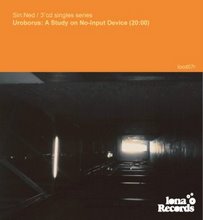
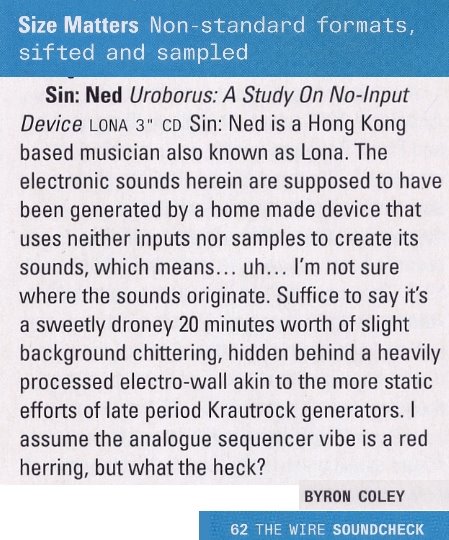 叫人意想不到的發現。於第271期的The Wire雜誌中,竟有一篇關於自己於Lona發表的3” CDR “Uroborus: A Study On No-Input Device”之短評。
有趣的是,名氣大如 The Wire的雜誌也會忙中有錯:
1. Sin:Ned不等於Lona。Lona是出版 “Uroborus: A Study On No-Input Device”的廠牌。
2. “Uroborus: A Study On No-Input Device”乃透過電腦及音樂軟件創作而成,並非自家製樂器。詳情可參閱 Lona Records 網頁。
不過能夠看見自己的作品在The Wire中被提及,無論如何也是一件可喜的事。
Monday, August 21, 2006
FM3+竇唯 - 后觀音
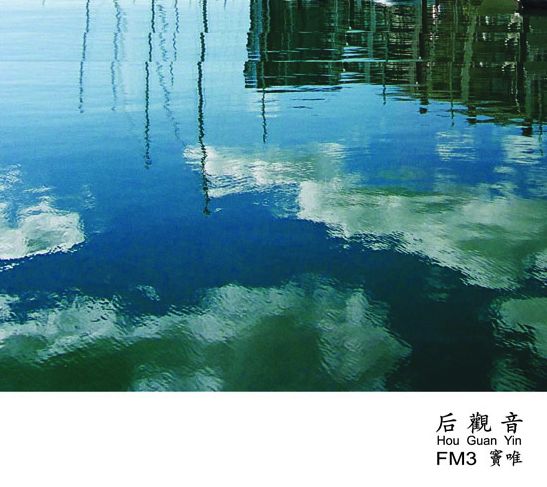 FM3這個植根北京,由Christiaan Virant及張薦組成的二人聲響藝術樂團,繼Buddha Machine之後,再次帶來另一神來之筆:后觀音。
仍然是充滿著破格和超越意味的概念轉化。單是演奏陣容,已足以叫人眼前一亮。FM3加上竇唯,絕對是個充滿破格性的合作。還有身兼詩人、樂評人、實驗演奏家及地下音樂推手的顏峻作聲音助興。而負責出版后觀音這張專輯的,又是由Alok (Slow Tech Riddim) 所策劃的香港實驗廠牌Lona Records。這一切,都叫人對FM3+竇唯這張新專輯萬分期待。
與我們所見慣的近年那些已變成陳腔濫調及膚淺的所謂”Crossover”不同,后觀音是一次極深層的多向性融合。
音樂上,它不著痕跡地,化合著FM3的實驗性環境聲像及竇唯的搖滾樂根源,造出一個相互引發及補充的演奏狀態。FM3的聲像如流質物滲透著竇唯的敲擊,誘發出其潛聚待發的環境音樂及後搖滾似的特質。同時間,竇唯那恰到好處的節奏元素,又將FM3聲像中的抽像動態,含蓄地彰顯成形。
再深一層地聆聽,你又會發覺,FM3及竇唯彷彿是在以西方實驗音樂的演奏模式,去理解及感悟東方哲學思想的抽像概念。疏落的聲響,彷彿水墨畫技法般畫黑留白。重要的,不在於發聲的部份,而在於發聲與發聲之間,於空白位置所遺下的氛圍餘音所造就的冥想空間。憩靜而平和得近乎禪的意味。甚至乎是一種近乎無為的演奏狀態。同樣地畫黑留白,全張專輯十一首作品,只有第二、五、九及十一首分別命名「烏」、「無」、「吾」、「悟」,其餘曲目都只是留著空白。從「烏」(黑->色) 到「無」(白->空) 再到「吾」(自我) 及最後「悟」(頓悟) 的過程,透過的,是對於虛空的參悟冥想。這不是很富東方哲學色彩的佈局嗎?
重實驗感而又不乏可聽性,概念化之餘又不流於理論化。一切,都能從聲響的角度以聆聽的方式細意體會及感悟。一種完完全全道地中國的實驗音樂。
FM3 Web Site
Lona Records Web Site
(原文見MCB Online)
Sunday, May 28, 2006
東京壞音學黑馬 - Analogic
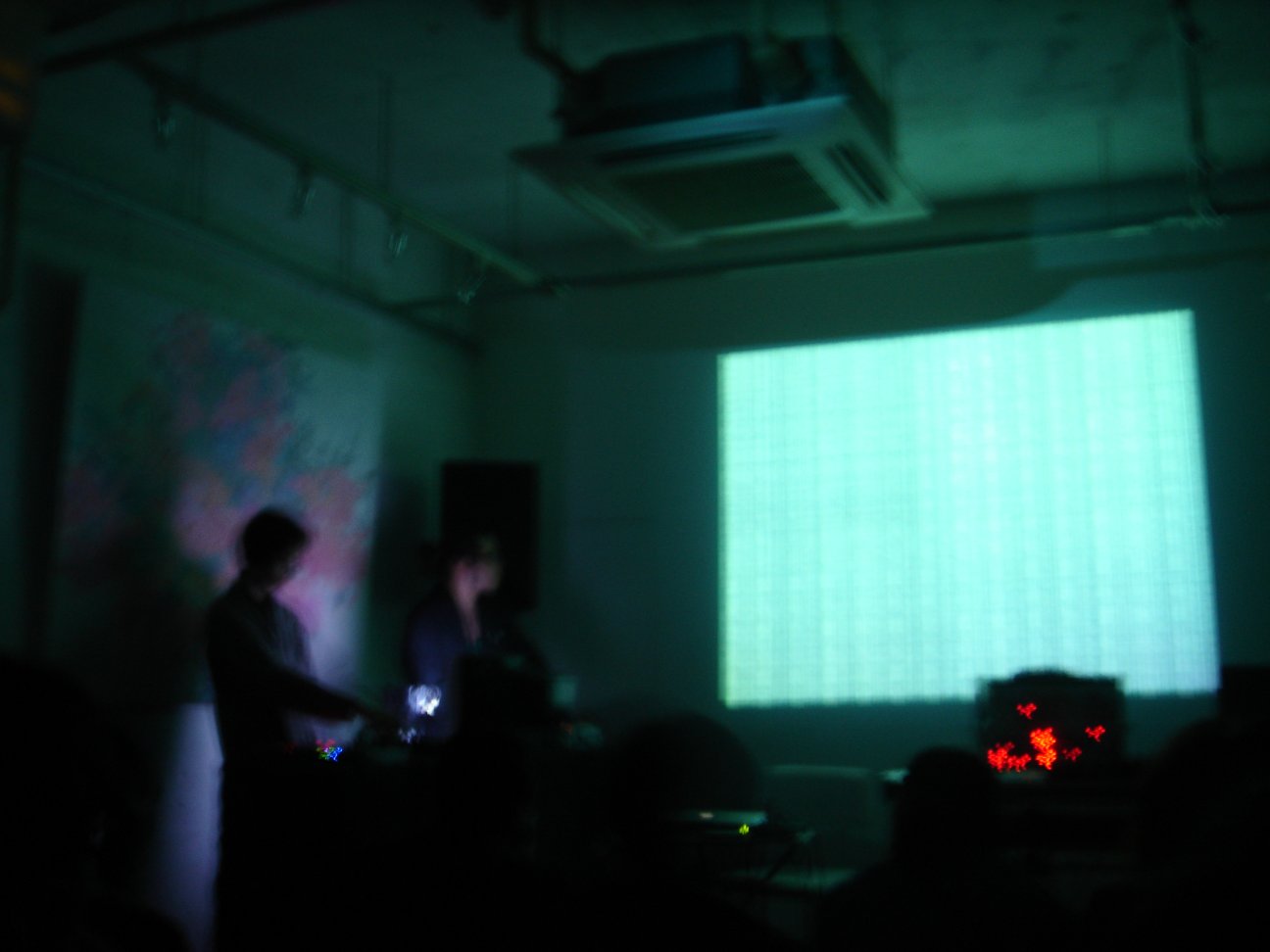
看著Analogic的自主制作DVD-R,電視「雪花」與壞音扭動,歪曲地傳繹出一種古怪的節奏律法。又想起四月二十二號晚Analogic於日本東京Sendagaya,Loop-Line三周年紀念之演出。還記得同行的JL問,那不是像看著一部壞電視的「雪花」嗎?的確是這樣。但這些電視「雪花」也確實是叫人看得很耐人尋味。
正確一點地形容,我們其實像從一個精神分裂病患眼中,從接受不良的電視畫面及壞音訊號中解讀著外星人的秘密信息。雖然同有更具名氣的Carl Stone及坪口昌恭 (Tokyo Tribe),但Analogic的壞音學派手法實在來得更富創意。沒有電腦及正規樂器,只有一部電視及攝錄機的視像迴路,和混音器及效果器材,發放出訊號雜音與電視畫面的同步相舞動,效果十分不可思議。
有興趣的話,不妨到Analogic或Loop-Line的網頁走一趟。
Analogic Web Site
Loop-Line Web Site
Sunday, March 19, 2006
從儉德大厦走進子山公園
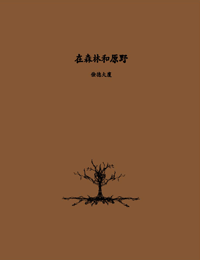 這幾天聽著儉德大厦的專輯「在森林和原野」,很是感動。實在很久沒有聽過如此叫我動容的本土音樂。加上那些插畫,一切是那麼奇幻。有如一筆筆細水長流的線條,帶出自粒粒實而不華的音符,將一種內心境像,形像化地,幻化成一首首充滿神話原型意像的童話詩編。彷彿是Novela那種童話國度,以Scenic (一隊美國Post-Rock組合)的音樂意像重新演繹。
有一晚,突然想起久沒聯絡的子山。
於是在網上踫踫運氣。結果找到了她的子山公園。
電影「V煞」的V說,巧合只是一個幻像。
原來早幾天前,她也剛到訪過maitreyana.com。
儉德大厦,原來是她的友人。
感覺是很奇妙的東西。
有時很多巧合,我們不以為意,以為只是偶然。
但其實,我們的意識,我們的感覺,遠比我們的理牲理解更精明。只是我們不以為意而矣。
我們都被教育到精於荒廢自身理性以外的意識。
我們的感覺,原來比我們看得更通更透。
大概這就是C.G. Jung所說的Synchronicity。
這也是音樂美妙之處。
順帶一提 ,喜歡閱讀及書本的朋友可必到子山公園走一趟。她手造的布書套十分精緻。
Subscribe to:
Posts (Atom)

 Posts
Posts